
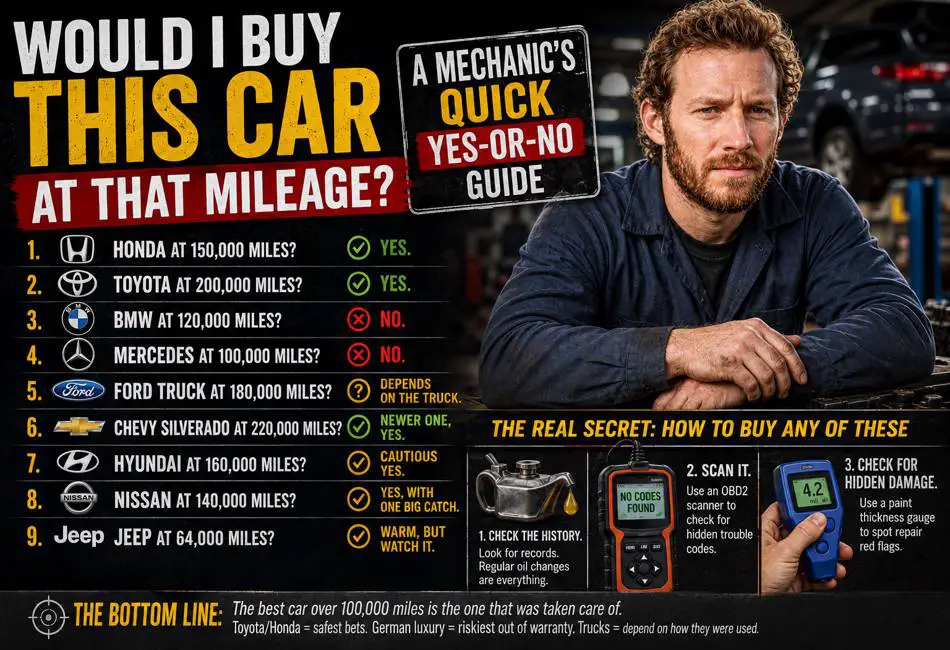
People love to play a game with me. They name a car and a mileage, and they want a straight yes or no. Would you buy it? No hedging, no “it depends,” just the gut call from someone who’s seen what these vehicles look like underneath.
So let’s play. Here’s my honest yes-or-no on some of the most common cars and the mileage where people start to get nervous. Remember as you read: my answers are really about the engine and how these brands tend to age, not a guarantee about any single car. History and maintenance always have the final say.
1. Honda at 150,000 Miles? Yes.
Easy yes. A well-kept Honda at 150,000 miles is barely middle-aged. These engines are built to run, and 150k is nowhere near the finish line for them. Find one with service records and you’re looking at years of reliable driving left.
2. Toyota at 200,000 Miles? Yes.
Another easy yes, maybe the easiest on this list. Toyota built its entire reputation on engines that shrug off big mileage. At 200,000 miles, a maintained Toyota has already proven the engine is sound.
This is exactly the kind of car I point people toward, and it’s why Toyota shows up so often among the cars that keep going even after 200,000 miles.
3. BMW at 120,000 Miles? No.
Here’s where I start saying no. A BMW out of warranty at 120,000 miles makes me nervous, and it should make you nervous too. By this point the expensive failures (timing components, the oil filter housing, cooling parts) are all on the table at once.
The car may run beautifully the day you buy it and hand you a four-figure bill a month later. Not worth the gamble for most buyers.
4. Mercedes at 100,000 Miles? No.
Same story, and if anything I’m even firmer here. There’s just no to the Mercedes at 100,000 miles. The complexity that makes these cars feel luxurious is the same complexity that makes them expensive to keep running once the miles climb. Repairs are pricey, and they tend to arrive in clusters.
5. Ford Truck at 180,000 Miles? Depends on the Truck.
Trucks are a different animal. A full-size Ford truck at 180,000 miles can absolutely be a yes if it was maintained and not worked to death. The key question with any truck is how it was used.
A truck that towed heavy loads every day for a living is very different from one that mostly ran errands. Check the frame for rust and the service history for proof it was cared for.
6. Chevy Silverado at 220,000 Miles? Newer One, Yes.
Same rule as the Ford. A Silverado at 220,000 miles can still have plenty of life, especially a newer-generation truck that’s been looked after.
These engines are tough. Just judge it on condition and history rather than the big number, because a well-maintained high-mileage truck often beats a neglected low-mileage one.
7. Hyundai at 160,000 Miles? Cautious Yes.
Modern Hyundais have come a long way, and a maintained one at 160,000 miles can be a reasonable buy. I’d want to see records, particularly oil change history, since some of these engines are sensitive to neglect. Cared for, it’s a yes. Neglected, walk away.
8. Nissan at 140,000 Miles? Yes, With One Big Catch.
A Nissan at 140,000 miles gets a yes from me, as long as it isn’t a CVT-heavy model that was abused. Nissan’s continuously variable transmissions can be a weak point if they weren’t maintained. If the transmission shifts smoothly and the fluid was serviced, you’re fine. If it shudders or hesitates, that’s your cue to keep looking.
9. Jeep at 64,000 Miles? Warm, but Watch It.
A Jeep at 64,000 miles is low mileage and runs warm with life left, but Jeeps reward owners who stay on top of maintenance. The mileage isn’t the worry here. The worry is whether the electrical and cooling systems were looked after. Get it inspected and you’ll know quickly.
The Real Secret: How to Buy ANY of These
Notice that almost every “yes” came with the same condition: was it maintained? That’s the whole game. The brand and the mileage give you a starting point, but the car’s history is what actually decides it.
So before you buy any used car, do two things. First, get a documented service history and confirm the oil was changed on schedule, because regular oil changes are what keep an engine alive, and this guide on when to change your car’s oil explains why. Second, plug in an OBD2 diagnostic scanner before money changes hands.
It pulls stored trouble codes the seller may not mention and turns a guessing game into facts. For the brands prone to expensive surprises, I’d also keep a paint thickness gauge handy to spot hidden accident repairs that a fresh coat of paint is hiding.
The Bottom Line
So which car is best over 100,000 miles? The one that was taken care of. That’s not a dodge, it’s the truth. A maintained Toyota or Honda is the safest bet on this list, the luxury German cars are the riskiest once the warranty ends, and the trucks live or die by how hard they worked.