
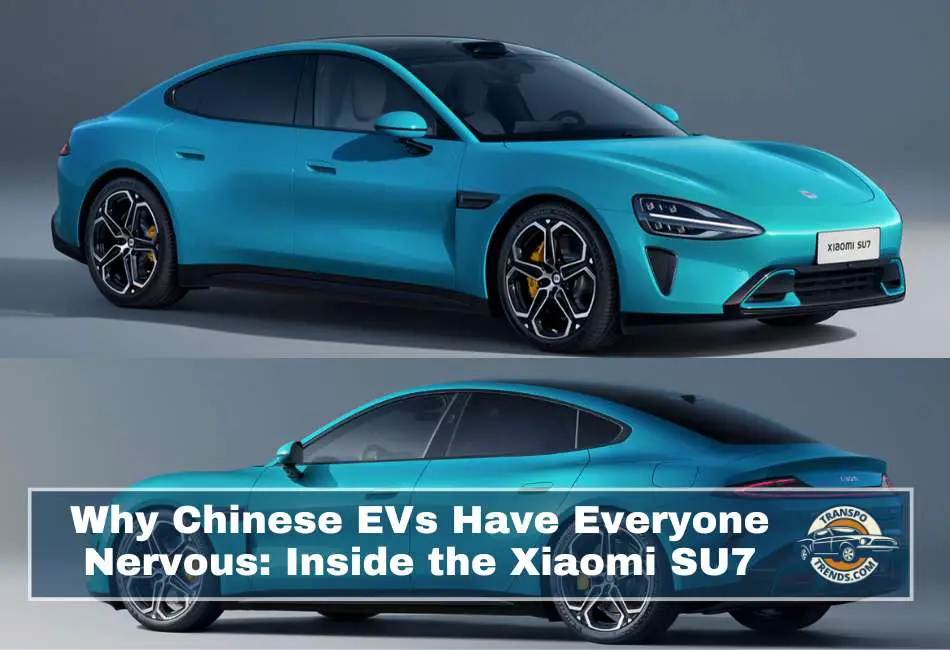
On paper, it’s just another electric sedan. In reality, it’s a checklist of things Western carmakers keep promising “for the next generation,” already shipping today at a price that feels almost unfair.
This article isn’t about hype. It’s about what this car actually is, what it’s like in detail, and why cars like it are forcing a serious rethink of what an EV can be at around $42,000.
Meet the Xiaomi SU7: A Smartphone Company Builds a Car
Xiaomi is best known for doing one thing extremely well: stuffing a lot of technology into products that cost less than you’d expect.
Phones, tablets, headphones, robot vacuums, air purifiers, smart home gear—Xiaomi already lives in the “everything” category. Now it has added a car.
The SU7 lineup mirrors smartphone naming:
- SU7
- SU7 Pro
- SU7 Max
- SU7 Ultra
The car used as a reference here is the SU7 Max, priced at roughly 299,000 CNY, about $42,000 USD at current conversion.
Key specs
- Fully electric four-door sedan
- 101 kWh battery
- Dual-motor all-wheel drive
- 673 horsepower
- Around 320 miles of rated range
On paper, that puts it in the same performance neighborhood as a Tesla Model 3 Performance, which currently sits much higher on the price ladder in most markets.
But specs are the boring part. The interesting story starts when you walk around it.
Exterior: A Greatest Hits Album of Expensive Cars
Because Xiaomi isn’t a legacy automaker, it doesn’t have decades of design language to protect. No historical grille to keep. No signature taillight shape it “must” reuse.
So instead, the SU7 looks like a curated collection of design cues from more expensive brands:
- The headlights have a distinct supercar flavor, very reminiscent of high-end sports brands.
- The hood and front fenders carry smooth, sculpted lines you’d normally expect on something from Lotus or other premium European marques.
- The side profile echoes sleek performance sedans, with a low, flowing roofline and coupe-like stance.
- A full-width rear light bar anchors the back, a design language increasingly associated with luxury brands.
- A fully active rear wing deploys and retracts like a high-end grand tourer, both for downforce and for drama.
Finished in a unique purple metallic paint, the car doesn’t scream “budget EV.” It looks like it belongs in the same parking lot as cars that normally cost much more.
Interior: This Does Not Feel Like a $42,000 Car
A lot of mid-priced EVs have a pattern: impressive spec sheet, underwhelming interior. The SU7 breaks that pattern completely.
Materials and layout
Inside, the SU7 feels more like a $60,000–$70,000 premium sedan:
- Comfortable heated and ventilated leather seats
- A heated steering wheel with a clean, performance-focused design and minimal buttons
- An Alcantara headliner wrapping the ceiling
- A huge tinted glass panoramic roof over the cabin
- 25 speakers and a serious audio system with surround sound and active noise control
The cabin design is minimalist but not bare. There are physical controls where they matter and screens where they add value.
Screens and controls
The driver sees:
- A bright head-up display (HUD) aligned ahead of the road
- A compact digital cluster behind the wheel
- A 16-inch central touchscreen acting as the main command center
Crucially, Xiaomi didn’t fall into the “all-touch, no buttons” trap. The center console includes:
- A power on/off button
- Physical temperature controls
- Fan speed buttons
- Switches for the rear wing and air suspension lift
That means you can adjust climate or ride height by touch, without hunting through menus.
Clever details everywhere
The interior is full of small, thoughtful touches:
- A flashlight is docked in the center storage area, charged by the car’s battery, ready for emergencies.
- There are air-cooled 50W wireless charging pads near the top of the dash—perfect for high-power Xiaomi phones that match the car.
- Storage is generous, with smartly shaped compartments around the cabin.
And that’s just the front row.
Rear Seats: Built-In Tablets and Real Comfort
The back of the SU7 isn’t treated like an afterthought.
- Rear passengers get generous legroom and a comfortable seat shape.
- Screens mounted for the second row are full Xiaomi tablets, integrated into the car’s system.
- The audio system and ambient lighting extend through the whole cabin, not just the front.
The result feels more like a tech-forward lounge than the rear bench of an affordable sedan.
Software: What Happens When a Phone Company Designs a Car OS
Most automakers struggle with software. Interfaces are clunky, laggy, or decades behind smartphones.
Xiaomi started from the opposite direction: it already makes fast, polished operating systems for millions of phones and tablets. The SU7 leans heavily into that strength.
Seamless integration with the Xiaomi ecosystem
If you use Xiaomi products, the car becomes another node in the network:
- Wireless screen mirroring from compatible phones
- Deep integration with Xiaomi smart home devices (like security cameras)
- Sync for messages, navigation, and media using a familiar account system
For those outside the Xiaomi ecosystem, there’s still wireless Apple CarPlay—running on one of the biggest, most impressive CarPlay canvases currently in a car.
Navigation that doesn’t ruin the music
One standout software trick: the car routes navigation voice prompts to a speaker in the driver’s headrest, while music continues uninterrupted through the rest of the system.
No more full-cabin “TURN LEFT IN 200 METERS” cutting off the best part of a song. The driver hears the instructions clearly; everyone else keeps enjoying the audio.
It’s a small design decision that shows how much thought has gone into the user experience.
Modular Interior: Hardware You Can Rearrange
One of the SU7’s most unique features is its modular interior hardware system.
Scattered around the dashboard and console are discreet mounting points. Xiaomi sells a collection of accessories that snap into these points:
- An additional speedometer/trip display
- A magnetic phone mount
- A high-power USB hub for charging extra devices
- Microphones for karaoke or in-car communication
- Other small modules that customize the driving or passenger experience
This lets owners choose how “maximalist” or “minimalist” they want their cabin to be:
- Prefer a clean, simple dashboard? Leave the modules off.
- Want more screens, more info, more controls? Add modules where you need them.
It’s an approach borrowed from tech accessories, transplanted into car design in a way most automakers haven’t tried yet.
Driving Experience: Multiple Personalities in One Car
On the road, the SU7 behaves like a modern EV should: quiet, quick, and smooth. But the way it changes character with drive modes is what stands out.
Comfort mode
In its default setting:
- The air suspension keeps the ride soft and controlled, smoothing over bumps and potholes.
- The accelerator response is gentle and predictable.
- Steering effort is light but accurate.
- Regenerative braking is tuned for confidence rather than aggressiveness.
In this configuration, it feels like a relaxed, refined sedan for everyday use.
Sport and Sport+ modes
Turn the drive mode selector, and the car shifts personality:
- The UI graphics switch to more performance-oriented displays, including power usage and g-force meters.
- The accelerator becomes sharper and more immediate.
- Steering heavies up to give more feedback.
- Suspension tuning stiffens for better body control.
With over 600 horsepower available, launch control, and sub-3-second 0–60 mph capability, the SU7 moves firmly into performance territory.
It may not quite match the sharpest driving dynamics of high-end European sports sedans, but it sits impressively close—especially given the price point.
Active seat bolsters
During cornering, seat bolsters subtly tighten on the opposite side of the turn, helping hold the driver in place.
It’s a trick usually reserved for very expensive luxury SUVs and performance cars. Seeing it in a sedan at this price level is another sign of how aggressively Xiaomi has packed in features.
Refinement: Quiet, Solid, and Well Put Together
Power and screens are easy to show off in a spec sheet. Build quality is harder to communicate—until you sit in the car.
Inside the SU7:
- Road noise is low, thanks to good insulation and acoustic glass.
- Wind noise is well controlled, even at higher speeds.
- Motor whine is barely noticeable.
- Active noise cancellation further cleans up the sound environment.
Combined with premium materials and solid panel fit, the car feels genuinely upscale. It doesn’t sound like a budget EV trying to pretend; it feels like a serious, well-engineered product that happens to be priced aggressively.
Driver Assistance: High-End Hardware Waiting for Local Software
On top of the windshield sits a LiDAR unit, flanked by multiple cameras—a clear indication of advanced driver-assistance ambitions.
In its primary market, the SU7 offers systems (often referred to as Pilot Pro and Pilot Max) designed to handle most of the work on many roads, providing:
- Lane keeping
- Adaptive cruise control
- Obstacle detection and avoidance
In markets where it isn’t officially sold yet, those capabilities may be limited or not fully optimized, but the hardware foundation is clearly there.
The important point: the SU7 isn’t just a fast EV. It’s a platform for sophisticated automated driving features, with the sensors and computing to match.
So Why Are Cars Like This Such a Big Deal?
There’s no single magic component inside the Xiaomi SU7—no alien battery chemistry, no impossible motor design.
What makes it stand out is how much it combines in one package:
- Strong performance and range
- Polished, phone-grade software
- Deep ecosystem integration
- Premium materials and build quality
- Unique modular hardware
- Refined suspension and NVH
- Advanced driver-assistance hardware
- All at a price that undercuts many Western rivals
Most cars manage three or four of those pillars. Very few hit nearly all of them at once, especially at this price.
Will EV Cars Like the Xiaomi SU7 Dominate Everywhere?
Right now, the biggest barrier isn’t technology—it’s policy and logistics:
- Import tariffs
- Trade rules
- Safety and regulatory approvals
- Local manufacturing requirements
- Political pressure to protect domestic industries
Those factors are what currently prevent a $42,000 Xiaomi SU7 from rolling into US showrooms and going head-to-head with established players.
But globally, the picture is shifting. As these vehicles expand into more markets, especially in Europe and other regions, they raise expectations for:
- Value
- Software quality
- Interior tech
- Performance per dollar
And once customers experience that combination, it becomes difficult to settle for less.
What the Xiaomi SU7 Really Represents
The SU7 is not just “a Chinese EV with good specs.” It’s a signal.
It shows what happens when:
- a tech company with massive scale
- tight control over its supply chain
- deep experience building consumer electronics
…decides to build a car the same way it builds phones: compete hard on value, push software integration, and use hardware modularity to let customers customize their experience.
There’s no guarantee that every Xiaomi car—or every Chinese EV—will be this strong. But the bar has undeniably been raised.
And that’s the part that matters most for drivers everywhere:
competition like this forces the entire industry to step up.
More range. Better software. Higher quality. More complete cars.
If that’s the future, then the global EV race is about to get very interesting.