
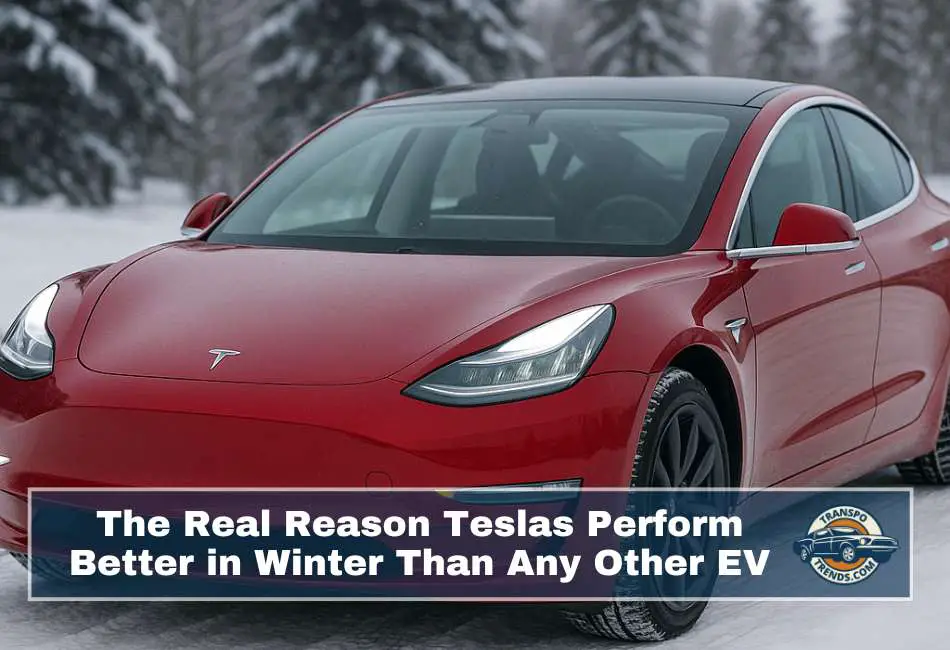
Cold climates expose the truth about electric vehicles: not all EVs are designed the same way. Some lose significant range. Some struggle to heat the cabin efficiently. Some take far too long to charge. And some simply don’t feel stable on snow-covered roads.
And then there’s Tesla — a brand that didn’t become known for winter performance by accident.
Tesla has spent more than a decade refining cold-weather engineering, and the result is a collection of features that work together like a system: heating, battery management, traction, software, and seamless user controls.
Here’s why Tesla consistently outperforms other EVs when temperatures drop.
1. Heat Pumps: The Heart of Tesla’s Cold-Weather Advantage
All modern Teslas use a high-efficiency heat pump, which radically improves winter driving performance.
In most EVs, heating the cabin drains the battery quickly because resistive heating is energy-intensive. Tesla’s heat pump changes that equation completely.
How Tesla’s Heat Pump Works
- It captures heat generated by the battery and motors.
- It recycles that heat through a closed-loop system.
- It warms the cabin and glass surfaces without drawing huge amounts of energy.
- It stabilizes temperatures during long-distance winter driving.
This system isn’t a simple component — it’s a full thermal architecture designed to keep passengers warm and keep the battery at an efficient operating temperature.
Why it matters
The result is:
- Faster cabin warm-up
- Lower winter energy consumption
- More consistent range
- Smoother battery performance in freezing temperatures
Tesla’s heat pump is one of the biggest reasons the brand leads in winter conditions.
2. Intelligent Defrosting: Heating More Than Just the Windshield
Tesla doesn’t just warm the cabin. It warms the critical parts of the entire glass structure.
The Tesla app allows the driver to activate Defrost Mode, which heats:
- the windshield
- the panoramic top glass
- the rear glass
- the side windows
Most EVs only heat the front windshield. Tesla heats the glass around the cabin too.
Why that matters
- Side windows thaw, so you can open the door without the window sticking to the trim.
- Glass expansion is even, preventing stress cracking.
- Visibility improves quickly, reducing risk during early-morning drives.
The system is extremely efficient because it’s integrated with the heat pump.
3. Remote Heating Through the App: A Full Warm Car Without Using Battery Power
The Tesla app is a major winter advantage.
With a tap, the driver can:
- heat the entire cabin
- defrost all glass
- warm the steering wheel and seats
- unlock the car even if exterior handles are frozen
And the best part:
If the vehicle is plugged in, preheating uses wall power — not battery power.
This preserves range while ensuring the vehicle is already warm before departure.
Other EVs offer partial preheating, but Tesla’s integration is deeper:
- The app can thaw frozen door handles.
- Doors unlock even if external buttons freeze.
- Climate control is faster and smarter thanks to the thermal core.
Cold-weather usability is clearly built into the design.
4. Superior Traction and Stability in Snow
All EVs benefit from instant torque, but Tesla’s system takes winter traction to another level.
Tesla’s traction control stands out because:
- It monitors wheel slip hundreds of times per second.
- It adjusts torque at each wheel with extreme precision.
- It uses motor control rather than brake-based correction.
- It eliminates lag, improving stability on ice and packed snow.
When combined with proper winter tires, the system delivers:
- confident acceleration
- predictable cornering
- minimal fishtailing
- rapid correction on icy roads
This is why Tesla owners consistently report feeling secure even in harsh snowstorms.
5. Door Handle Freeze Protection
Traditional door handles can freeze shut in severe cold.
Tesla’s solution:
Open the car using the phone app — even if handles are frozen.
Because the app serves as a digital key:
- No physical keyholes freeze.
- No mechanical leverage is needed.
- The door opens electronically.
This eliminates one of winter’s most frustrating issues — yanking at frozen handles while your hands go numb.
6. Consistent Battery Conditioning for Cold Weather
Tesla’s battery management system is one of the most advanced in the industry.
In cold weather, the system:
- automatically warms the battery
- regulates cell temperatures during driving
- reduces power loss from cold chemistry
- restores regenerative braking sooner
- protects long-term battery health
And if the driver sets a Tesla Supercharger as the destination, the vehicle pre-warms the battery for fast charging — automatically.
This prevents slow winter charging, a common problem in many non-Tesla EVs.
7. Snow-Focused Software Features
Tesla’s winter advantages aren’t just hardware — they come from continuous software updates that improve cold-weather behavior.
Over time, Tesla has rolled out improvements such as:
- enhanced cabin heating algorithms
- faster windshield defrosting
- improved HVAC efficiency
- better battery preconditioning
- smarter traction control tuning
- winter-optimized charging curves
Unlike traditional vehicles, Tesla grows more winter-capable each year through updates alone.
Most automakers freeze HVAC and driveline behavior once the car leaves the factory. Tesla constantly evolves it.
8. Efficient Glass Heating for Passenger Comfort and Safety
Tesla’s ability to heat multiple glass panels isn’t just a convenience. It impacts:
- heat retention
- battery efficiency
- driver comfort
- visibility during storms
Because large glass roofs lose heat in winter, Tesla designed:
- insulated layered glass
- targeted heating zones
- efficient conduction patterns
- internal thermal routing from the heat pump
The cabin stays warm without wasting energy.
9. Reduced Dependency on Resistive Heating
Resistive heating is the least efficient method of warming an EV cabin. Many early EVs relied heavily on it, leading to dramatic winter range drops.
Tesla dramatically minimized the use of resistive elements through:
- heat pump integration
- heat scavenging
- thermal routing through the Octovalve
- multi-panel glass heating
- preconditioning
- efficient airflow management
The result:
- longer winter range
- less cabin energy waste
- faster interior warming
Tesla doesn’t eliminate resistive heating entirely — it uses it strategically, not constantly.
10. Continuous Cold-Weather Optimization
This is Tesla’s biggest winter advantage:
The company tests, updates, and optimizes its vehicles for cold weather more frequently than any other EV manufacturer.
Tesla runs:
- cold-soak tests
- snow course simulations
- battery thermal stress tests
- traction control tuning
- range optimization modeling
Then incorporates improvements through:
- new hardware
- refined algorithms
- software updates
- seasonal behavior optimizations
Where traditional cars stay the same year after year, Teslas adapt.
Final Verdict
Cold weather exposes how well an EV is engineered. Tesla’s advantage comes from a combination of:
Thermal Engineering
- heat pump
- Octovalve system
- multi-panel glass heating
- efficient cabin warming
Software Intelligence
- predictive battery conditioning
- smart defrost
- real-time traction adjustments
- faster winter charging
Convenience and Usability
- remote climate activation
- frozen-handle bypass
- app-based door entry
- integrated glass heating
Safety and Control
- superior traction control
- stable acceleration on snow
- predictable handling
Tesla didn’t get better in winter because of one feature — it became the best by designing the entire vehicle around efficiency and thermal stability.
Winter will always challenge EVs.
But Tesla remains the brand that meets that challenge head-on with engineering that works where it matters most: in real-world conditions, on real winter roads.