
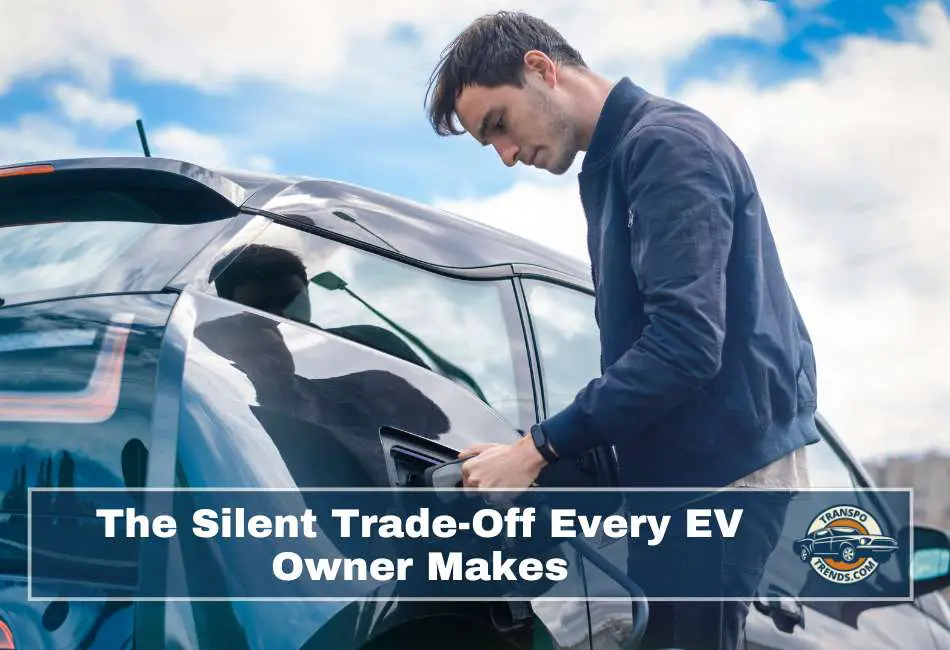
Let’s be honest — the pitch for electric vehicles has always been simple: they’re clean, fast, and cost less to run.
But behind the zero-emissions badge and silky smooth torque, every EV comes with an invisible price tag. And it’s not about money.
It’s about trade-offs.
From battery wear to charging bottlenecks to oddly shaped trunks — there are compromises baked into the EV experience that most people don’t talk about.
But you should. Because understanding them might be the difference between loving your EV and quietly regretting it.
Let’s talk about the five biggest trade-offs automakers rarely mention — and what they actually mean.
1. Fast Charging Is a Double-Edged Sword
You’ve seen the promise: “Up to 80% charge in 18 minutes.”
And yes, EVs can charge that quickly — sometimes. But here’s the thing: charging your EV at max speed isn’t always good for the battery. In fact, it’s kind of like slamming an energy drink and expecting your body to feel amazing after.
Frequent fast charging creates more heat and stress for the battery. Over time, that stress degrades the battery’s health.
And while some cars do a better job managing this than others (hello, Porsche Taycan and its thermal buffering), the physics are the same. More heat equals more wear.
If you’re relying on fast charging daily — especially in cold or hot climates — you’re sacrificing long-term battery life for short-term convenience.
Many EV owners end up charging slower at home anyway. It’s gentler on the battery, cheaper per kWh, and honestly less stressful than hunting for a public charger on 5% battery.
2. Range Isn’t Real — It’s an Estimate
Every EV has an official range number stamped on the spec sheet. But here’s the fine print they don’t print big enough: range is a lab-based estimate, not a promise.
Real-world range is influenced by:
- Outside temperature
- Driving speed
- Tire pressure
- HVAC usage (AC/heater)
- Wind and elevation
- How much stuff is in your trunk
Let’s say you own a Hyundai Ioniq 5 rated for 303 miles. On a sunny 70°F day doing 55 mph? Sure, you might hit that.
But crank the heat on a freezing January commute while doing 75 on the highway? More like 200–220 miles. Maybe less.
Automakers are getting better at predicting real-world range, and some even show estimated range dynamically based on your driving style (like Lucid and Rivian).
But it’s still a game of variables. Over time, you learn to expect less than advertised — and plan accordingly.
3. Battery Degradation Is Real (But Manageable)
Batteries are consumables. That means every charge and discharge cycle eats away a tiny bit of capacity.
Most modern EVs lose 1–2% of range per year on average. That doesn’t sound like much, but after five years, your 300-mile EV might only do 270. Not catastrophic, but noticeable.
And if you:
- Live somewhere hot
- Charge fast regularly
- Park outside every day
- Frequently charge to 100%
…then your degradation will likely be worse.
Here’s where it gets tricky. EVs don’t “fail” suddenly when batteries degrade. But the way you use your car — your daily commute, road trips, errands — might need to change as the range shrinks.
Some owners only notice when a favorite charger is no longer within safe round-trip range in winter.
4. Infrastructure Is Still Catching Up
The EV revolution feels unstoppable. But the infrastructure revolution? Still stuck in traffic.
In the US, non-Tesla charging networks like Electrify America, EVgo, and ChargePoint are improving — but reliability varies wildly by location.
In Europe, charging is better in countries like Norway and the Netherlands, but more fragmented elsewhere.
Even Tesla’s Supercharger network — widely seen as the gold standard — can get congested during holiday weekends or near major cities.
And once NACS becomes universal, that congestion could get worse before it gets better.
What this means practically:
- You have to plan. Apps like PlugShare and A Better Route Planner are essential.
- You may wait. At busy stations, especially in winter, expect to queue.
- You might pay more. Fast charging is rarely as cheap as home charging — and prices fluctuate.
This isn’t about doom and gloom. Just realism. If you’re counting on EVs to be as frictionless as gas stations in every corner town, we’re not quite there yet.
5. Space and Packaging Are Not Always Gains
One of the original EV promises was interior freedom: no engine, no transmission tunnel, more space.
And it’s true — to an extent.
Many EVs, like the Kia EV6 or Tesla Model Y, have massive interior volume and under-floor storage (frunks!).
But that space has to come from somewhere. And in many cases, that “somewhere” is the trunk floor height or rear passenger foot space.
Batteries are heavy and bulky. Even when placed low in the chassis (the “skateboard” design), they raise the cabin floor and can shrink usable cargo volume.
Some crossovers end up with tiny frunks or shallow rear trunks that look great until you try to load two suitcases.
EVs with air suspension (like the Mercedes EQS SUV) can lower themselves for cargo loading, but not all have that luxury.
Bottom line: Not every EV is a cargo-hauler, even if it’s shaped like an SUV.
Bonus Trade-Off: The Software Ceiling
This one’s sneaky.
Modern EVs are software-defined vehicles. That’s cool — it means features can improve with over-the-air (OTA) updates. But it also means:
- You might not get full features unless you pay for subscriptions
- Some cars (especially legacy brands) have clunky or glitchy infotainment
- New bugs can appear after an update
Tesla, Rivian, Polestar, and Lucid all ship meaningful OTA updates. Legacy automakers? Still catching up.
So while your car might feel modern on day one, it could feel dated a year later — unless the brand prioritizes software as much as hardware.
So… What’s the Real EV Deal?
Here’s the truth: none of these trade-offs are deal-breakers.
They’re just reality.
EVs are wildly efficient, whisper-quiet, low-maintenance, and surprisingly fun to drive. But like any technology shift, they come with a new set of expectations.
If you treat your EV like a gas car — drive until it’s empty, pull into any charger you see, expect no range drop in winter — you’ll be disappointed.
But if you adjust your habits, learn your car’s quirks, and charge smart, it quickly becomes second nature.
Summary Table: What You Trade for Electric Driving
| Trade-Off Area | What You Gain | What You Give Up / Manage |
|---|---|---|
| Charging Speed | Fast top-ups at public DC stations | More battery wear, especially with frequent use |
| Advertised Range | Long theoretical range | Reduced real-world range in cold, fast, or uphill drives |
| Battery Degradation | Years of usable driving | Gradual range loss (1–2% per year on average) |
| Infrastructure Access | Growing network of fast and home charging | Inconsistent availability or reliability (esp. non-Tesla) |
| Interior Space | No engine = potential for creative design | Raised floors, smaller trunks in some designs |
| Software & Features | OTA updates, smart integrations | Potential bugs, paywalled features, UX frustration |
| Upfront Cost | Lower maintenance, fuel savings over time | Higher sticker price + occasional charger upgrades |