
When we think of pickup trucks, we often think of rock-solid reliability, power, and long-term performance. Trucks are the workhorses of America — built to haul, tow, and tackle any terrain.
But what happens when these mighty machines suffer from severe mechanical failures? Not the kind of cosmetic annoyances you can live with — but the sort of hidden flaws that can leave you stranded and staring down the barrel of a $10,000 repair bill.
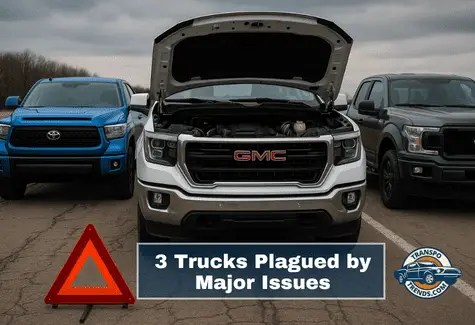
Here are three popular trucks that hit the headlines not for their power or payload capacity, but for major engine failures that rocked the truck-owning community. This is not just about failures — it is also about how manufacturers stepped up (or did not).
1. Toyota Tundra (2022–2023)
The 2022 Toyota Tundra debuted with a fully redesigned powertrain — a 3.4L twin-turbocharged V6 replacing the trusted V8. It had the makings of a hit. But within months, disaster struck.
Toyota was forced to recall approximately 102,000 units of the 2022–2023 Tundra and Lexus LX600 due to machining debris left inside the engine.
These leftover metal shavings blocked oil passages and destroyed engine bearings. Some engines failed with as little as 3,000 miles on the clock.
Owners described their trucks dying mid-drive, with a horrific knock and sudden power loss. The defect was serious enough that Toyota opted for full engine replacements — a rare and costly move.
Toyota’s response was swift and transparent. By July 2024, the company had already begun replacing affected engines, allocating over $500 million to get it done. New engines were built without the defect, restoring faith in the Tundra’s future reliability.
Key points:
- Affected: 2022–2023 Toyota Tundra and Lexus LX600
- Problem: Metal debris in engine causing bearing failure and loss of oil pressure
- Fix: Full engine replacement at no cost
2. GM Trucks (2021–2024, 6.2L V8)
Chevrolet Silverado. GMC Sierra. Cadillac Escalade. All of them praised for their 6.2L V8 (engine code L87). But under the hood, things were not quite right.
A combination of valve lifter failures and defective crankshafts and connecting rods led to catastrophic engine failures. Thousands of owners reported lifter ticks, metal shavings in oil pans, and blown motors — sometimes while driving on the highway.
The issue? Poorly machined internal components leading to oil starvation and spontaneous engine destruction. In response, GM recalled 721,000 vehicles in April 2025.
The recall included engine inspections, oil system updates (switching to 0W-40 synthetic oil), and engine replacements where necessary.
Owners of luxury trucks felt blindsided. These were $70,000+ vehicles, and many required engine replacements before hitting 20,000 miles. Lawsuits and NHTSA pressure finally pushed GM into action.
Key points:
- Affected: 2021–2024 Silverado, Sierra, Tahoe, Suburban, Yukon, Escalade (6.2L V8 only)
- Problem: Defective crankshafts, rods, and valve lifters causing catastrophic failure
- Fix: Inspection, oil change, or full engine replacement under recall N252494001
3. Ford Bronco/F-150 (2021–2022, 2.7L EcoBoost)
The 2.7L EcoBoost V6 was meant to deliver punchy performance in a compact package. Instead, it became infamous for a defect with intake valves that could crack and fall into the combustion chamber — a literal engine-destroying flaw.
The affected vehicles included early-build Ford Broncos, F-150s, Edge, Explorer, and Lincoln SUVs from 2021–2022.
Failures occurred in engines with under 10,000 miles. The cause? Improperly heat-treated valves during a supplier’s production window in 2021.
By late 2024, Ford launched a recall affecting 90,000 vehicles, issuing recall number 24S55. Rather than replace every engine, Ford will run a start-cycle-based stress test to identify vulnerable engines. Units that fail will receive a new engine.
Drivers described the engine suddenly stalling, with a clunk and complete loss of power. Ford’s transparency in identifying the problem and changing suppliers has reassured many that newer models are safe.
Key points:
- Affected: 2021–2022 Broncos, F-150, Edge, Explorer, Lincoln Aviator/Nautilus (2.7L/3.0L V6)
- Problem: Intake valves cracking and falling into combustion chamber
- Fix: Engine inspection stress test and replacement if needed
Summary Table
| Truck (Model Years) | Major Issue | Manufacturer Response |
|---|---|---|
| Toyota Tundra (2022–2023) | Machining debris in engine causing oil blockage, bearing failure, and complete engine seizure | Recalled ~102,000 vehicles; replacing entire engines at no cost. 2024+ models built without this defect |
| GM Trucks/SUVs (2021–2024, 6.2L V8) | Crankshaft and rod manufacturing defects, plus valve lifter collapse. Leads to oil starvation and total engine destruction | Recalled 721,000 vehicles; conducting inspections, oil upgrades, or full engine swaps under recall N252494001 |
| Ford Bronco/F-150/etc. (2021–2022, 2.7L/3.0L) | Defective intake valves crack and drop into engine cylinders, causing sudden loss of power and catastrophic damage | Recalled ~90,000 vehicles; engines tested for failure risk using a cycle-count and stress test. Faulty engines will be replaced. Supplier and process fixed |
Final Thoughts
Reliability is the bedrock of truck ownership. And while mechanical defects can shake driver confidence, the true test lies in how automakers respond.
In each of these cases, the brands involved issued recalls and took responsibility — but the damage to their reputations was real. If you own one of these vehicles, check your VIN for recalls. Because no one wants to be stranded by a truck they trusted.