
Winter has a funny way of turning confident drivers into nervous rookies. One night you go to bed with dry pavement and a quiet driveway; by morning your car looks like it has been entombed under a layer of ice thicker than a rhinoceros hide.
The road that was perfectly normal yesterday now looks like a cheap ice rink from a shopping mall. And yet—people still rush outside, grab the wrong tools, press the wrong buttons, assume the wrong things, and somehow expect the laws of physics to bend out of sympathy.
They do not.
This is the season when small mistakes can turn into cracked windshields, burnt wiper motors, stalled engines, exploding batteries, or a slow slide into a ditch that makes your entire neighborhood pause and stare. So today, we walk through the biggest winter-driving mistakes people make—plus the smart, mechanically grounded ways to stay safe.
Mistake #1 — Pouring Hot Water on an Icy Windshield
People love shortcuts. Hot water seems like the easy cheat code: “The ice will melt faster!”
Yes…and your windshield may shatter faster too.
When near-boiling water hits sub-zero glass, the temperature difference expands the outer layer quicker than the inner layer. This stress can crack the glass instantly.
On modern cars, that problem is ten times worse. Windshields now house sensors, cameras, lane-assist modules, heating elements, and calibration points. Replacing one is not fifty bucks—it can be 600–1,000+ euros plus recalibration.
If you really want a shortcut, here is the right one:
Lift the wipers, use a proper ice scraper, warm the cabin on defrost, and let the glass rise in temperature gradually.
Mistake #2 — Running the Wipers Over Ice
This one is painfully common:
- Frozen wipers
- Frozen windshield
- Driver says: “Eh, it will break loose.”
- Driver turns on wipers
- Wipers attempt to move
- Motor fights frozen blades
- Fuse pops, or worse, motor burns out
Suddenly your visibility is gone until you repair it. And trust me—wiper motors are not cheap, nor fun to replace on many modern cars.
The smart way?
Lift the wipers before the storm or lift them manually in the morning, scrape the ice fully, and then put them back down.
Your wiper motor will thank you. Your wallet will too.
Mistake #3 — Using the Scraper on Painted Surfaces
People get impatient, especially when late for work. Snow on the hood? Ice on the fenders?
So they take the ice scraper—the one with the hard plastic blade—and treat the body panels like frozen meat.
Congratulations: you now have thousands of micro-scratches that will someday need buffing or repainting.
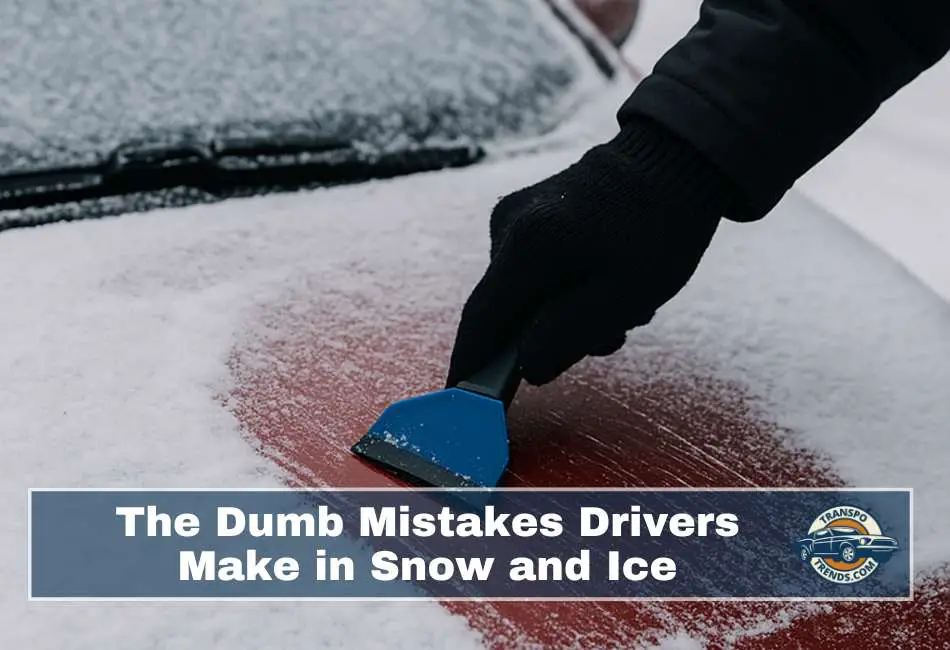
Use the brush side on paint. Save the scraper for glass.
Mistake #4 — Taking the Wrong Car Into the Storm
This mistake is half ego, half ignorance.
Drivers assume:
- “Front-wheel drive is enough.”
- “Rear-wheel drive is fine if I go slow.”
- “All-season tires mean I can handle anything.”
- “It is only a little ice.”
No.
Tires matter more than the car itself.
A front-wheel-drive Toyota on summer tires will struggle more than a rear-wheel-drive pickup on good winters. And a two-wheel-drive truck is a disaster in icy conditions unless you love fishtailing like a rodeo bull.
If you must drive in winter storms:
- Use snow tires on all four wheels
- Prefer AWD/4WD if available
- Avoid steep hills
- Keep speed low enough that ABS can actually help
Physics is undefeated. Respect it.
Mistake #5 — Turning Off Traction Control
Some drivers think traction control is a fun-killing nanny. “It slows me down!” “It cuts power!”
Yes. That is because you were losing traction.
Traction control is not perfect, but it is the difference between a controlled slide and the unintentional YouTube moment where your car drifts gracefully into a mailbox.
On snow and ice, keep traction control ON. Always.
Unless you are:
- Rocking the car out of deep snow
- Driving a rally car (you are not)
- Purposely drifting (you should not)
Leave it on. It works.
Mistake #6 — Underestimating Hidden Ice Under Fresh Snow
Fresh snow is innocent-looking. White, fluffy, harmless.
And underneath?
A sheet of glass-slick ice waiting to send your car sideways.
This is how people slide gently (and humiliatingly) into ditches, mailboxes, curbs, poles, fences, or each other.
Drive slow, brake gently, and assume every hill is icy beneath the powder.
Mistake #7 — Using Jumper Cables Wrong in the Cold
Cold weather kills weak car batteries—fast. The chemical reaction slows down, the oil thickens, and suddenly that 7-year-old battery that was “fine last summer” refuses to crank.
So people instinctively grab jumper cables, flag a neighbor, and attach the clamps between a running car and a dead one.
Here is the danger:
Modern cars have sensitive ECUs. When two alternators connect during a jump, power surges can fry electronics in both vehicles.
I have seen it happen. Multiple modules. Big repair bills. The smart approach?
A good one has:
- Reverse polarity protection
- Spark-free connectors
- Its own internal power supply
- Zero risk to the other vehicle’s electronics
You could even touch the clamps together—nothing happens until it senses a proper battery connection.
No sparks. No explosions. No ECU damage.
Throw one in your trunk. It is the single most valuable winter tool you can own.
Mistake #8 — Thinking 4WD Makes You Invincible
Four-wheel drive helps you go—it does not help you stop.
People forget this and end up flying down hills thinking they are piloting a tank.
Then they touch the brakes and discover:
- Four wheels lock
- ABS pulses
- Momentum continues
- Vehicle slides like a curling stone toward the bottom
4WD helps you climb hills. It helps you avoid getting stuck.
But if the road is ice, you will still slide.
Drive slowly enough that stopping is realistic—not theoretical.
Mistake #9 — Ignoring the “Stay Home” Rule
This one is simple:
If the road is a skating rink and you do not absolutely need to go out…
Do not go out.
Nothing ruins a day faster than sliding into:
- A ditch
- A wall
- A guardrail
- Another driver
- A police cruiser (the worst)
Sometimes the smartest winter move is to make cocoa, stay inside, and wait for salt trucks.
Mistake #10 — Forgetting That Batteries Hate the Cold
At –10°C, a car battery has half its normal cranking power.
Combine that with thick oil and a cold starter motor and you have a recipe for “click click click… nothing.”
The smart winter checklist:
- Clean your terminals
- Test your battery before winter
- Keep a jump pack ready
- Avoid 10-year-old batteries (they will betray you)
Batteries are the #1 winter failure point. Prepare for it.
Smart Driver Winter Survival Table
| Situation | Wrong Move | Smart Move |
|---|---|---|
| Icy windshield | Pouring hot water | Warm engine, lift wipers, scrape properly |
| Frozen wipers | Turning them on | Lift first, melt ice, avoid motor strain |
| Snow on body panels | Scraping paint | Use brush only on paint |
| Hills in icy conditions | Driving fast or with 2WD | Use 4WD if available, go slow, avoid steep hills |
| Rear-wheel drive truck | Turning off traction control | Keep traction control ON |
| Battery dead in cold | Jumping with cables | Use lithium jump starter |
| Snow covering hidden ice | Assuming traction | Slow speed, gentle braking |
| Car not winter-ready | Relying on all-season tires | Use proper winter tires |
| Thick snow layer | Accelerating hard | Gentle throttle, maintain traction |
| Deep cold start | Ignoring battery health | Test, clean terminals, keep jump pack |