
Most people only think about their car in two moments: when it is running perfectly… and when it suddenly is not. And the truth is that the gap between those two moments is almost always preventable.
Today’s guide is a simple one, but it is one of the most important pieces of car advice you will ever read. These are the essential checks every driver should perform at home.
These small habits save you money. They protect you from being stranded. They extend the life of your engine, your brakes, your tires, and every system that keeps you safe on the road.
This is the exact checklist you should run through every six months, though many of these steps are worth doing even more often. Think of this as your personal “vehicle health routine”.
Let us begin where every good inspection starts: outside the car.
1. Tires
Tires are the unsung heroes of your vehicle. They carry the entire weight of your world — your commute, your family, your groceries, your future — and yet most people never look down long enough to check them.
You only need to inspect three things: tread depth, tire pressure, and wear pattern.
Tread Depth
Every tire has tiny bars molded inside the grooves called wear indicators. If you run your finger across the tread and you no longer feel that “step down” into the groove — if it feels flat across the indicator — the tire is done.
Not “almost done.”
Not “I will stretch these another month.”
Done.
A bald tire is a sponge on wet pavement. It hydroplanes easier, loses grip faster, and turns panic braking into a coin toss.
Tire Pressure
Inside your door jamb is a sticker showing the correct PSI for your car.
Not the number on the tire.
Not the number your friend told you.
When your pressure is too low:
- You burn more fuel
- Your tires wear unevenly
- Your steering becomes vague
- Your hydroplaning risk skyrockets
When your pressure is too high:
- The center of the tire wears out early
- Your ride becomes harsh
- Your stopping distance increases
A cheap pressure gauge and thirty seconds is all it takes.
Wear Pattern
Tires are storytellers. They reveal how the car has been driven and how well it has been maintained.
- Worn center → Overinflated
- Worn edges → Underinflated
- Worn on one side → Alignment problem
That last one is especially important.
Bad alignment does not just wear out tires. It throws off your suspension and reduces braking stability. It turns a simple fix into an expensive future repair.
2. Brakes
You do not need to remove the wheel to inspect the brakes.
Most vehicles allow you to look right through the spokes and see your brake pads.
A new brake pad has around 12 millimeters of material.
You should begin planning to replace it once it reaches 3 millimeters.
If you wait until it hits 1–2 millimeters, metal-on-metal grinding begins — and the repair bill jumps from $150 to $700+.
Most pads even include a built-in screeching tab that screams at you when it is time to change them.
Check the Shock Absorber Too
Your suspension also needs a quick look:
- Any leaking fluid on the shock absorber means the internal seal has failed.
- Any cracked spring is a structural hazard.
- Any bent or rusted component is a safety risk.
You can check most of this by simply turning your steering wheel all the way left, then all the way right, and looking in from the wheel well. You do not need tools.
3. Engine Oil
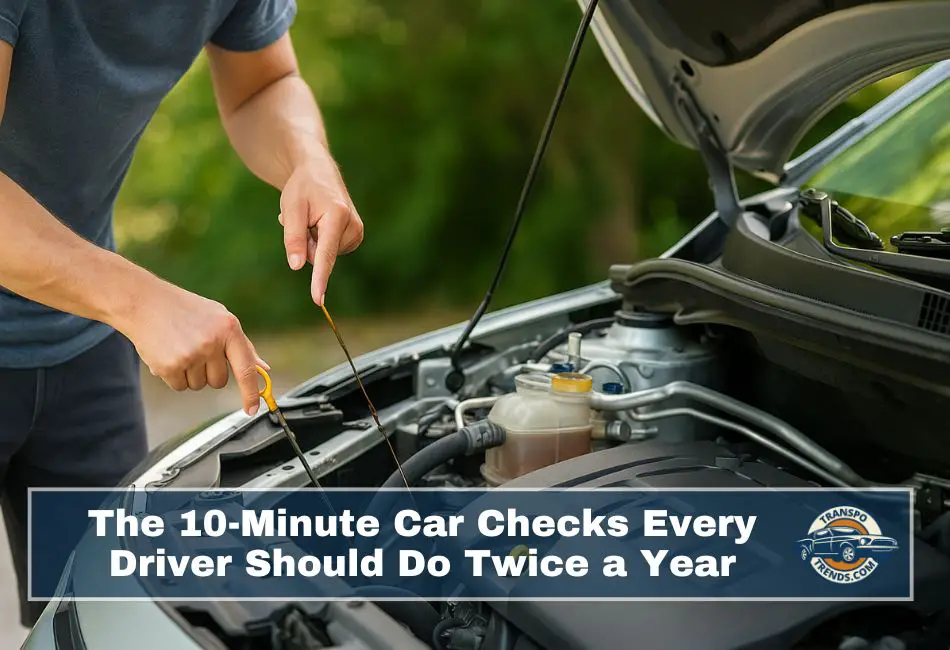
Checking oil with a dipstick is one of the simplest but most powerful things you can do.
How to check it properly:
- Pull the dipstick out.
- Wipe it completely clean.
- Insert it fully.
- Pull it out again and read the level.
Between the two marks — that is your safe zone.
If the level is near the bottom, add half a quart, wait a moment, and recheck.
But the color matters too:
- Clear to amber → Normal
- Dark brown → Ready for a change
- Milky or frothy → Danger: coolant contamination
That last one is the early warning sign of head gasket failure. Catching it early will save you thousands.
4. Other Fluids
Different cars have different systems, but these are the universal ones:
Brake Fluid
Look at the reservoir.
There will be a MIN and MAX line.
If it is below MIN, you may have a leak or your brake pads may be worn.
Brake fluid is not something you casually top up without knowing why it is low.
Coolant
Your coolant tank also has MIN and MAX markings.
Coolant expands as it heats, so do not open the radiator cap when hot.
Low coolant often signals:
- A slow leak
- A failing water pump
- A loose hose
- Or sometimes a worn radiator cap
Windshield Washer Fluid
Not a safety risk — until you are driving through snow, salt, or dust and suddenly cannot see.
Top it up regularly.
5. Filters
Two filters protect your engine and your lungs: the engine air filter and the cabin air filter.
Engine Air Filter
Usually tool-less, it snaps open with clips.
A little debris is fine.
But if the filter is dark, clogged, or furry with leaves, bugs, or dust — replace it.
A restricted air filter makes your engine work harder and burn more fuel.
Cabin Air Filter
This one hides behind your glove box.
It is the reason your AC does not smell like an old basement.
If it is full of leaves, fuzz, or gray dust, swap it. It affects airflow and the health of your HVAC system.
6. Wipers and Lights
Wipers
Brittle rubber, visible cracks, or streaking on the windshield mean it is time for new ones.
Wipers are cheap. Poor visibility is not.
Lights
You cannot see your own brake lights — but other drivers depend on them.
Use a friend, a mirror, or your phone camera to check:
- Headlights
- High beams
- Turn signals
- Reverse lights
- Brake lights
A burned-out bulb is a ticket waiting to happen, and a safety hazard long before that.
The Real Value of a 10-Minute Inspection
The truth is simple:
Cars rarely fail suddenly. They whisper first.
A tire wears unevenly.
A brake pad gets thin.
A filter clogs.
A fluid drops low.
Catching problems early is the difference between a $15 fix and a $1,500 repair.
And doing these checks every six months — or even better, every three — keeps your vehicle running smoother, safer, and more efficiently.
Your car is not just transportation. It is part of your daily life. Treat it with a little consistency, and it will reward you with reliability for years.
Summary Table: Your Complete At-Home Vehicle Health Checklist
| Category | What to Check | What Is Normal | What Requires Action |
|---|---|---|---|
| Tires | Tread depth | Finger dips into groove | Runs flat across wear bar |
| Tire pressure | Matches door sticker PSI | Too high or low → adjust | |
| Wear pattern | Even across surface | Inside/Outside/Center wear | |
| Brakes | Pad thickness | 12 mm (new) | 3 mm → replace soon |
| Noise | Quiet | Screeching indicator | |
| Suspension | Shocks & springs | No leaks, no cracks | Fluid leaks, broken spring |
| Engine Oil | Level | Between MIN and MAX | Below MIN or no oil |
| Color | Clear/amber | Milky → coolant contamination | |
| Fluids | Brake fluid | Between MIN and MAX | Below MIN → inspect |
| Coolant | Correct level | Low → possible leak | |
| Filters | Engine air filter | Light dust | Dark, clogged → replace |
| Cabin air filter | Light debris | Heavy dust/debris | |
| Safety | Wipers | No cracks | Streaking or brittle |
| Lights | All functioning | Any bulb out |