
There’s a moment every winter—usually right after the first real thaw—when you crouch beside your car, look underneath, and feel a small surge of worry.
The exhaust has changed color.
The control arms look older than they should.
Bolts that were silver in October are now turning brown.
And you realize, again, how winter treats metal.
Salt doesn’t care what you drive.
Slush doesn’t care how much you waxed the paint.
Brine doesn’t care whether your car is new or ten years old.
If you live anywhere near Michigan, Wisconsin, Ohio, New York, Pennsylvania, Vermont, or Ontario, you already know the truth:
Winter eats cars from the bottom up.
That’s why rustproofing has become a yearly ritual for many people who want their vehicles to last more than a few winters in the salt belt.
Some do it themselves.
Some take their cars to a shop.
Some wait too long and deal with the result.
If you want your car to survive the long haul, it helps to understand what actually works, what doesn’t, and how rust protection really functions.
This guide breaks down the whole process in the simplest way possible.
Why Rust Forms So Aggressively in Winter
Rust isn’t complicated.
It’s oxygen, moisture, and bare metal.
That’s it.
But winter changes the equation. Salt accelerates corrosion. Brine spreads into places you never see. Meltwater gets trapped in the frame. Temperature swings create condensation inside sealed metal sections.
The underside of your car becomes a small chemistry experiment.
- Steel heats up on the road.
- It cools down when parked.
- Moisture condenses inside rocker panels and frame rails.
- Salt from the road gets pulled into cracks, seams, welds.
- Oxygen does the rest.
Most rust starts inside the metal cavities, where you can’t see anything happening. By the time corrosion becomes visible from the outside, it’s already years into the process.
That’s one of the reasons many cars look fine until suddenly they don’t.
Why Most “Rust Coatings” Do Not Work Long-Term
Rustproofing has existed for decades, but not all products work the same.
Most people recognize the thick black rubber or wax undercoatings dealerships like to promote. They look strong. They look permanent. They make the underbody look clean.
But their weakness is simple:
They trap moisture.
Once water or salt gets behind a thick coating—through a crack, a rock chip, or a missed seam—it can’t escape. Rust forms silently underneath. By the time the coating fails and flakes off, a lot of damage has already happened.
This is why so many trucks and SUVs in the Rust Belt appear fine until a mechanic taps the frame and half of it crumbles.
Winter doesn’t care how clean something looks.
You need something that moves.
Oil-Based Rustproofing: The Only Method That Works Everywhere
Oil does something waxes and rubberized coatings can’t do.
It creeps.
Not metaphorically. Literally. It spreads across metal, into seams, around welds, and through narrow gaps where corrosion begins. It stays active. It displaces water. It pushes salt away from the surface.
Oil and water don’t mix.
That’s the whole secret.
The best rustproofing products—whether done by a shop or applied at home—are oil-based. Some are thinner with more creep. Some are thicker and hold on longer. But they all share the same purpose:
Keep moisture away from metal, year after year.
And unlike thick coatings, oil doesn’t hide rust.
If something is failing, you’ll see it.
You can treat it early instead of too late.
How Proper Rustproofing Actually Works
Whether you’re taking your car to a shop or doing it yourself, the process is always built around the same sequence.
Done properly, it protects the areas where rust begins—not just the parts you can see.
1. Protecting the Rubber Seals
Before any oil touches the car, technicians (or you) apply silicone to the rubber door and hatch seals.
Oil can soften rubber over time, so the silicone barrier prevents swelling or long-term damage.
It’s a small step, but important.
Most DIYers skip it. They shouldn’t.
2. Spraying Inside the Metal Cavities (The Most Critical Step)
This is where rustproofing either works or doesn’t.
The visible undercarriage is only half the story.
Most rust starts inside:
- Rocker panels
- Frame rails
- Inner door bottoms
- Quarter panels
- Weld seams
- Boxed steel sections
- Any area with poor drainage
Shops drill small, clean access holes—usually 8–10 mm wide. After the car is treated, these holes get filled with rubber grommets that look close to factory.
With the holes open, a long, flexible wand is inserted inside the metal cavities. The wand sprays a 360-degree fog of oil, coating everything inside those hidden spaces.
This step cannot be done with normal spray cans unless you have the right wand attachment.
Fluid Film and Woolwax both sell wand kits. They are worth the money.
If you skip the internal cavities, you miss the places where rust begins.
3. Rustproofing the Doors, Hood, and Trunk
Every vehicle has small seams and hidden welds in the doors, hood, and trunk areas. These places often collect moisture after winter storms or car washes.
A few seconds of fogging in each cavity prevents corrosion from starting in these thin, vulnerable areas.
Most people never think about it, but door rust almost always begins from the inside.
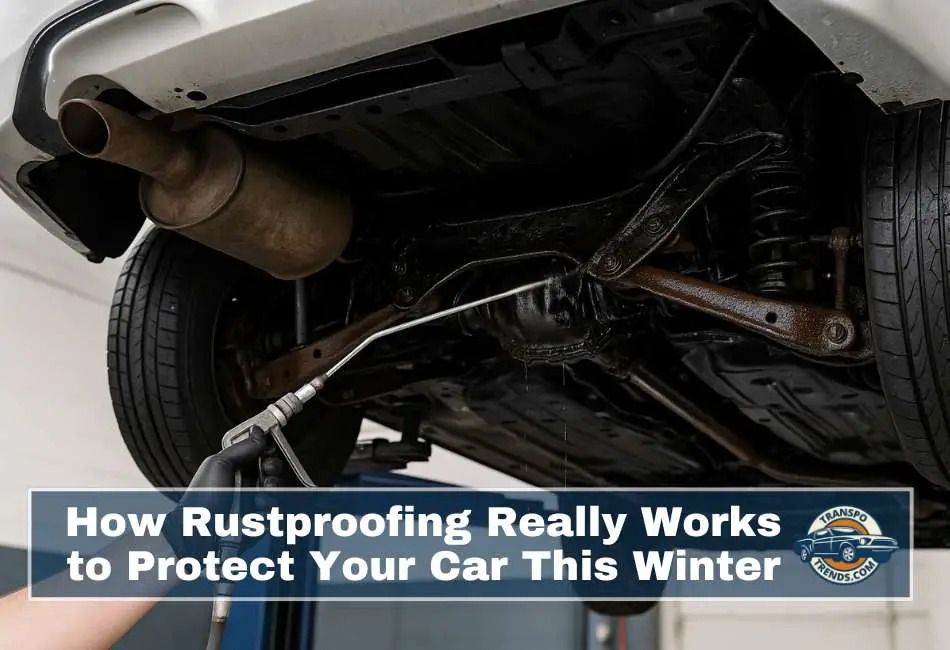
4. Spraying the Undercarriage and Suspension
This is the part people imagine when they hear “rustproofing.”
Technicians—or you—apply oil to the structural components beneath the car:
- Subframes
- Control arms
- Crossmembers
- Shock mounts
- Spring perches
- Brake line channels
- Fuel line channels
- Welded seams
The oil doesn’t harm bushings, electronics, or sensors.
Overspray on the exhaust burns off after a few days.
One practical benefit many people overlook:
everything becomes easier to unbolt later.
Mechanics prefer working on oiled vehicles.
Fasteners don’t seize.
Suspension parts don’t fuse together.
Old bolts come out like they should.
Longevity isn’t only about preventing rust—it’s about making the car fixable.
5. Drip Period and Final Cleaning
After the application, the car drips lightly for 24–48 hours.
It’s normal.
It’s part of the process.
It means the oil is creeping the way it should.
If you park on concrete, you can place cardboard underneath or use a degreaser after the dripping stops. Asphalt absorbs most of it with little trace.
Then you’re done for the year.
When Should You Rustproof?
People obsess over timing, but it isn’t complicated.
The ideal timing
Early spring, right after the freeze-thaw cycles begin.
The real truth
Any time of year works.
If winter has already started, it doesn’t matter.
Oil displaces water.
Salt neutralizers exist for pre-treatment.
It’s better to spray in February than not at all.
Consistency is what matters, not the month.
Once per year.
Every year.
That’s the formula.
How Long It Lasts
Oil-based rustproofing doesn’t stay forever. It slowly thins out, creeps, and protects until it needs to be reapplied.
- Fluid Film: 9–12 months
- Woolwax: 12–18 months depending on thickness
If you drive on salted highways regularly, you’ll want a full application yearly. If you live rurally or drive less in winter, you may stretch it slightly longer.
But the yearly habit is what keeps metal healthy.
Rust doesn’t attack your car on a schedule.
Your protection shouldn’t either.
What Rustproofing Changes Over Time
Most benefits are invisible at first.
Your car won’t look different.
It won’t feel different.
There’s no instant reward.
But the difference appears slowly, year by year:
- Bolts still turn.
- Brake lines stay intact.
- Fasteners don’t snap.
- Rocker panels don’t blow out.
- Frame surfaces stay solid.
- Suspension parts don’t seize to their bushings.
This is what people mean when they say rustproofing “extends the life” of a vehicle.
It preserves the parts you stop thinking about until something fails.
Winter doesn’t destroy cars all at once.
It does it quietly, from the inside.
Rustproofing reverses that direction.
Why New Cars Need Rustproofing Just as Much as Old Ones
Dealerships often suggest new vehicles have enough factory protection. They don’t.
New cars are more vulnerable than they look because:
- They use thinner metal.
- They have more welded seams.
- They rely heavily on boxed frame sections.
- They have tight internal cavities where moisture stays trapped.
Factory coatings are designed to survive shipping, not ten years of salted highways.
A new car is the best candidate for rustproofing because protection applied early prevents the internal corrosion cycle from ever starting.
Rustproofing and Existing Rust
Oil-based rustproofing won’t reverse damage, but it slows progression dramatically.
Surface rust becomes stable.
Edges stop flaking.
Existing corrosion grows more slowly.
The goal isn’t perfection.
It’s preservation.
You don’t need a clean undercarriage to start.
You just need to stop things from getting worse.
The Most Important Thing to Understand
Cars don’t die from mileage.
They die from rust.
People obsess over horsepower upgrades, exhaust systems, tunes, wheels, and detailing.
But none of it matters if the frame dissolves underneath you.
Rustproofing is not glamorous.
It doesn’t make the car faster.
It doesn’t change how it looks.
But it keeps the structure alive.
It keeps the vehicle safe.
It keeps bolts turning ten years from now.
It lets you keep a car long after most people give up on theirs.
If you drive in the Rust Belt, this isn’t optional.
It is maintenance.
Real maintenance.
The kind that genuinely changes how long a vehicle survives.
Final Thoughts
Winter wins by default.
Salt never sleeps.
Moisture never takes a break.
Oil-based rustproofing is one of the few tools that works with chemistry instead of against it. It protects the places you can’t see, and it buys your car years of life you won’t get any other way.
Whether you take your vehicle to a shop or do the yearly job yourself with Fluid Film or Woolwax, what matters is consistency.
Once per year.
Every year.
That’s how you stay ahead of winter.
That’s how cars survive in the salt belt.
And that’s how you keep a vehicle solid long after most people think it’s time to let go.