
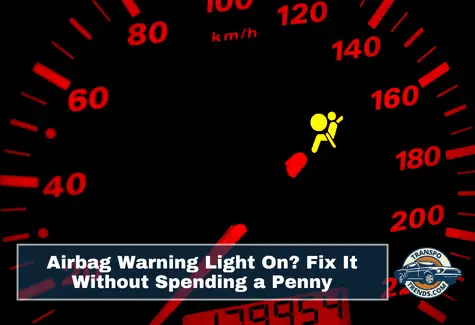
You are driving along, and suddenly—a bright light flashes on your dashboard. It is not the fuel light. It is not the check engine light. This one is different. A small icon, usually a seated figure with a circle in front of them, lights up in red or orange.
That light is the airbag fault light, sometimes referred to as the SRS warning light (Supplemental Restraint System). And when it comes on, it sends a clear message:
“Your airbag system is not working properly. In a crash, it may not protect you.”
Understandably, this causes worry. Some people rush straight to the dealership. Others ignore it, hoping it goes away. But what if the solution is simple, safe, and costs nothing?
In this guide, you will learn why the airbag light comes on, what it really means, and how to perform a safe reset that often clears the fault in minutes—no special tools, no expensive service, and no guessing.
What Is the Airbag Fault Light?
The airbag light is part of your vehicle’s safety diagnostics system. When you start the car, the system runs a check on every critical safety component—airbags, seatbelt tensioners, crash sensors, and more.
If everything passes the check, the airbag light switches off after a few seconds.
But if something is wrong—like a loose sensor, low voltage, or inconsistent readings—the light stays on. It is your car’s way of saying:
“I am not confident the airbags will deploy correctly in a crash.”
When Should You Be Concerned?
If the airbag light flashes and then stays lit while you are driving, you should be cautious. The car is still drivable, but your primary safety system is compromised.
Airbags are designed to inflate in milliseconds during a collision, cushioning your head and chest from dangerous impact. If the system is disabled, you are at a much higher risk of injury or death in an accident.
So what should you do? First, do not ignore it. Second, before spending hundreds of dollars at a shop, try the safe method explained below. It works in many cases, especially when the light was triggered by a low voltage issue or temporary sensor glitch.
What Triggers the Airbag Light?
The airbag system depends on a constant, stable power supply and reliable sensor signals. If anything interrupts these—even momentarily—the control module may disable the system as a precaution.
Here are some common causes:
- Low car battery voltage
- Battery replaced or disconnected recently
- Loose connectors under the seats
- Seatbelt tensioner faults
- Sensor communication errors
In many cases, the issue is not permanent damage, but a signal error stored in the car’s memory.
How to Reset the Airbag Light by Disconnecting the Battery
This method is effective when the airbag fault light is caused by voltage fluctuations or a recent battery replacement. It allows the vehicle’s computer to clear stored fault data and perform a fresh diagnostic check.
What You Will Need:
- A wrench or socket to fit your battery terminal bolts (usually 10mm)
- Gloves for safety
- Five minutes of time
Step-by-Step Instructions
Step 1: Locate the Battery
- Open the hood and locate the car battery, typically found in the engine compartment.
- Look for the red terminal (positive) and the black terminal (negative).
- Always work on the negative terminal first to safely disconnect power.
Step 2: Loosen the Negative Terminal
- Use your wrench to loosen the nut on the black negative terminal.
- You do not need to remove the nut completely—just loosen it enough to lift the terminal clamp off the battery post.
Step 3: Disconnect and Wait
- Gently lift the negative connector off the battery.
- Let it sit disconnected for 5 to 10 seconds.
This brief wait allows the vehicle’s capacitors and electronic modules to fully discharge. It is like restarting your computer—the stored error data will be cleared from memory.
Step 4: Reconnect and Tighten
- Place the negative connector back onto the battery post.
- Tighten the screw securely using your wrench.
- Make sure the connection is solid—a loose terminal can trigger the light again.
Step 5: Start the Car and Watch the Light
Now comes the test.
- Close the hood.
- Get into the driver’s seat.
- Insert the key or press the start button.
As the car starts up, the dashboard will light up and go through its usual system check.
- Watch the airbag icon.
- If the light turns off within a few seconds, the system has passed the check and is now active.
Success: The airbag system is functioning properly again, and you did not spend a single dollar.
Why This Works
The airbag control module stores error codes—especially if something unusual happens during startup, such as a weak battery or a power interruption.
When you disconnect the battery, it clears the temporary fault memory. Upon reconnecting, the system runs a fresh diagnostic scan.
If the fault was not critical, the airbag light will switch off, and the system will operate normally again.
This technique is safe, manufacturer-approved in many manuals, and effective for a wide range of makes and models.
When This Fix Will Not Work
While this battery reset works in many situations, it will not solve every problem. Your airbag light will likely stay on if:
- The sensor itself is damaged or unplugged
- The clock spring in the steering wheel is broken
- The seatbelt pre-tensioner has failed
- The airbag module has internal faults
- The vehicle has previously deployed airbags and they were not reset
In these cases, you will need to use an OBD-II scanner that can read and clear SRS fault codes, or consult a technician.
Dealership vs DIY: Know What You Are Saving
Let us be honest—most drivers dread visiting the dealership when the airbag light comes on. And for good reason.
| Repair Type | Dealership Cost | DIY Cost |
|---|---|---|
| Airbag light reset | $150 – $300 | Free |
| Battery disconnect reset | $0 (if DIY) | Free |
| Fault code scan (SRS module) | $100+ per scan | $25 (OBD scanner) |
| Airbag module replacement | $600 – $1200 | Variable |
For many drivers, this simple reset is the only fix needed. It gives you peace of mind and helps avoid unnecessary charges.
Summary
| Step | What to Do | Why It Works |
|---|---|---|
| Identify the airbag light | Icon stays lit on dashboard | Indicates fault in SRS system |
| Disconnect the battery | Loosen negative terminal and wait 5–10 seconds | Clears temporary fault data from the airbag module |
| Reconnect and tighten | Restore power and ensure solid contact | Prepares system for fresh diagnostic |
| Restart and check dashboard | Observe airbag light during startup | Confirms whether reset was successful |
Final Thought
Many drivers panic when dashboard warning lights appear. That is understandable. The airbag system is not something you want to gamble with.
But panic does not solve problems—understanding does.
This simple fix empowers you to take the first step. It does not bypass the system. It does not disable your airbags. It gives your car a clean slate to re-evaluate its own sensors under proper voltage. And that is often all it needs.
If the light goes off, you have restored a life-saving system—and gained confidence in the process. If it stays on, you have taken a responsible first step before seeking further help.
Your vehicle is not just a machine. It is a system. And sometimes, all it needs is a proper restart.