
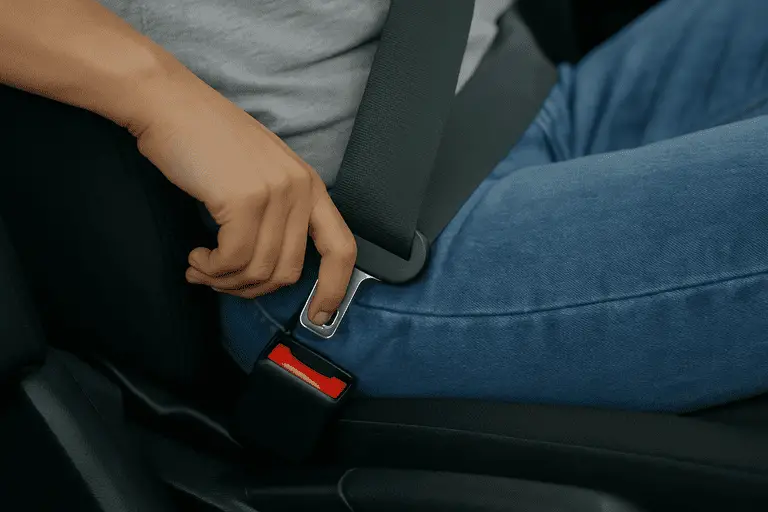
We strap them on every time we drive. Seat belts are perhaps the most familiar and ignored safety feature in every vehicle. But what if I told you that your seat belt hides more than just its locking mechanism?
That it could help you push a broken-down car, expose whether a car has been flooded, uncover if a vehicle was in an accident, or even help you escape if you are trapped inside?
Yes, the humble seat belt holds secrets that many drivers overlook. This article uncovers four hidden seat belt functions that could protect your life, your wallet, and your safety.
1. How to Use a Seat Belt to Push a Broken-Down Car Alone
Imagine this: your car breaks down in the middle of a narrow road or an intersection. You need to move it fast but no one is around to help you push. If the vehicle cannot be steered properly, moving it can become dangerous.
Here is a trick few drivers know: you can use your seat belt to push the car while steering from inside.
How to Do It:
- Open the driver’s door.
- Pull the seat belt out completely—as far as it will go.
- Loop it around your shoulder and chest, and then close the door gently so the belt stays taut but does not jam.
- Use your right hand to control the steering wheel through the open window or door.
- Begin pushing the car from the side using your body weight, keeping your left side against the frame and your feet angled to maximize power.
It might take effort, but the belt will give you a point of control to keep the vehicle from veering while you push. This technique is particularly useful for small to mid-size vehicles, especially if they are in neutral on a flat surface.
Note: Always ensure your hazard lights are on and the area is safe before attempting this.
2. How to Use the Seat Belt to Detect Flood-Damaged Cars
You are shopping for a used car. The paint looks fresh. The carpet has been shampooed. But what about water damage? A car that has been submerged or flooded is a mechanical time bomb, and unfortunately, not all sellers disclose the truth.
Here is a method to detect hidden water damage—using the seat belt.
What to Do During a Car Inspection:
- Sit in the driver’s seat and pull the seat belt to its full length.
- Take a close look at the belt fabric near the retractor, where it rarely sees daylight.
- Check for discoloration, mold spots, or embedded sand or grit.
If the belt smells musty, has signs of mildew, or contains silt—walk away from the deal. These are strong indicators that the car has been soaked in water. Even detailed cleaning cannot reach the innermost part of the retractor mechanism.
Why is this important? Flood-damaged vehicles often suffer from long-term electrical issues, corrosion, and compromised structural integrity. They are also more likely to fail inspections or suffer mechanical failures without warning.
3. Mismatched Seat Belt Date Tags Reveal Accident History
Here is another overlooked trick for verifying a used car’s history—checking the seat belt’s manufacturing date.
Every seat belt comes with a stitched label, usually found near the retractor end or beneath the plastic pillar cover. This label displays:
- Production month and year
- Manufacturer details
- Safety compliance info
How to Use This Info:
- First, check the vehicle manufacturing date. You will find it on the driver-side door jamb, often printed on a sticker with the VIN.
- Then check the seat belt date tag on the front passenger and driver seats.
- If the seat belt’s date is newer than the car’s build date, it may have been replaced.
That alone is not suspicious. But if only one side was replaced—or if the belt label is from a different brand—it may point to collision damage or airbag deployment. Belts often lock up or tear during accidents and are replaced as part of post-crash repairs.
Used car sellers do not always disclose accidents, especially if they were fixed outside of insurance records. This little detail can alert you to dig deeper or request a full vehicle history report via Carfax or AutoCheck.
4. Escape a Trapped Car Using the Seat Belt Buckle
Being trapped in a car is every driver’s nightmare—especially during floods, fires, or rollover accidents. Seat belts are designed to restrain you, but did you know they can also be used to break you free?
If your car crashes into water or the power windows fail after an accident, the pressure inside makes it nearly impossible to open the doors. That is where the seat belt buckle comes in.
How to Escape Using the Buckle:
- Unclip the belt and grab the metal tongue—the part you insert into the buckle.
- Find a corner of the side window, preferably the bottom.
- Use the pointed edge of the tongue to strike the glass with force.
- Do not aim for the center of the window. Glass is strongest in the middle and weakest at the edges.
Side and rear windows are made of tempered glass, designed to shatter into small pieces when broken correctly. Windshields, however, are laminated and much harder to break.
This is not a stunt—it is a life-saving technique taught by emergency responders worldwide. If you do not have a dedicated glass-breaking tool, your seat belt can be your next best option.
Recap: Seat Belt Secrets That Matter
| Seat Belt Function | How It Works | Why It Matters |
|---|---|---|
| Push Broken-Down Car | Loop belt over shoulder and steer through window | Helps steer while pushing solo |
| Detect Flood Damage | Pull full length of belt to inspect inner section for mold or sand | Reveals if car was submerged in water |
| Check for Accident History | Compare belt label date with car’s build date | Shows if belts were replaced after collision |
| Emergency Escape Tool | Use metal buckle tongue to shatter side window in an emergency | Offers exit when trapped inside |