
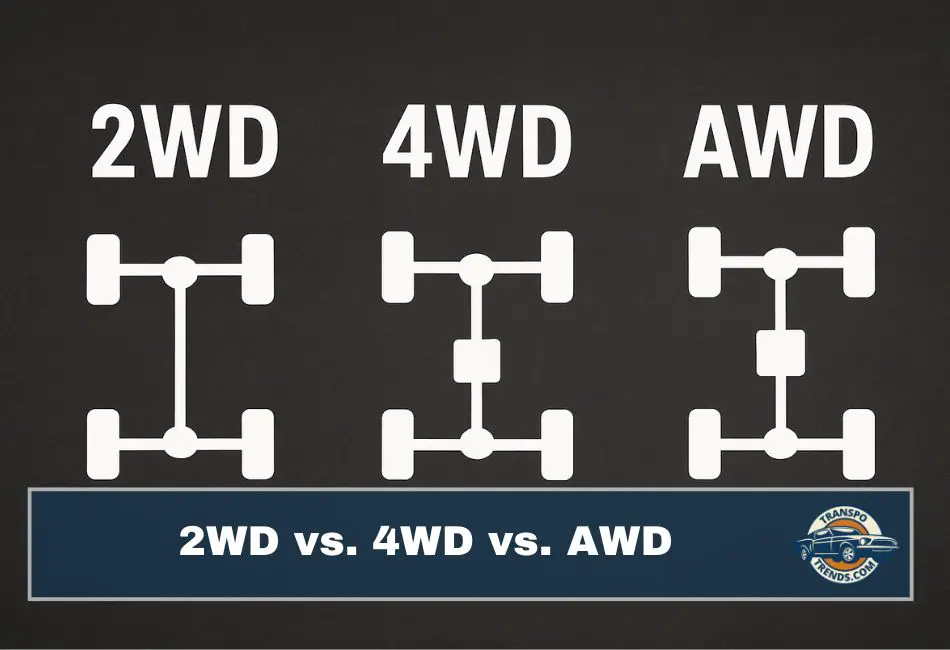
Whether you are a city commuter or a weekend adventurer, choosing the correct drivetrain—2WD, 4WD, or AWD—is more than just a spec sheet decision. It is about how your vehicle responds when conditions are not ideal.
What Is Two-Wheel Drive (2WD)?
Two-wheel drive is the simplest and most common drivetrain setup. Power from the engine is delivered to just two of the four wheels—either the front wheels (FWD) or the rear wheels (RWD). The other two wheels simply roll along for the ride.
How It Works
- Front-Wheel Drive (FWD): The engine sends power to the front wheels, which also handle the steering. It is the standard setup in most economy cars and family sedans.
- Rear-Wheel Drive (RWD): The engine powers the rear wheels while the front wheels steer. You’ll often find this in trucks, performance cars, and some luxury sedans.
Everyday Benefits
- Better fuel economy: With fewer components, less weight, and no extra driveshafts, 2WD delivers better mileage.
- Lower cost: Maintenance and purchase prices are often lower than their AWD or 4WD counterparts.
- Tighter handling: Especially in FWD cars, turning radius is sharper—perfect for city streets and tight parking garages.
Everyday Drawbacks
- Traction limitations: In snowy or muddy conditions, 2WD vehicles can struggle. If the driven wheels lose grip, the others cannot help.
- Less balanced power: In high-performance or slippery situations, RWD can oversteer and FWD can understeer.
Best For: City commuters, drivers in mild climates, and anyone who prioritizes fuel efficiency and simplicity.
What Is Four-Wheel Drive (4WD)?
Four-wheel drive—also called 4WD or 4×4—is designed for traction above all else. Power can be sent to all four wheels at once, giving you more control in rugged or slippery environments.
How It Works
Most 4WD systems are part-time, meaning you drive in 2WD mode until you choose to activate 4WD. That decision might come from hitting a steep grade, entering a muddy trail, or driving into a snowstorm.
To activate, you typically flip a switch, turn a dial, or pull a lever. In 4WD mode, all four wheels receive equal torque, increasing your odds of staying in motion even when one or two wheels are slipping.
Some vehicles also include low-range gearing, which multiplies torque for crawling through deep snow, over rocks, or up steep inclines.
Everyday Benefits
- Maximum traction: On off-road terrain or unplowed roads, 4WD can be the difference between getting home and getting stuck.
- Built for punishment: These systems are rugged, durable, and designed for demanding use.
- Low-range option: This is a game changer for those who regularly tow, climb, or traverse loose surfaces.
Everyday Drawbacks
- Fuel economy: Extra weight and mechanical complexity translate into lower mileage.
- Handling on dry roads: Driving in 4WD on dry pavement can cause drivetrain binding, which is hard on your components.
- Turning radius: 4WD systems usually have a wider turning circle, especially in trucks and SUVs.
Best For: Off-roaders, rural drivers, snowbelt residents, and anyone who routinely faces tough terrain.
What Is All-Wheel Drive (AWD)?
All-wheel drive is the comfort-zone option for modern drivers. It offers a balance between 2WD efficiency and 4WD traction—without requiring any driver input.
How It Works
Unlike 4WD, AWD systems are always on and managed by a computer. Sensors monitor wheel slippage and adjust power accordingly. If the front wheels begin to slip, the system automatically sends power to the rear wheels, and vice versa.
There are two main types:
- Full-time AWD: Power is always split between front and rear wheels.
- On-demand AWD: Most power goes to one axle (typically the front) until slip is detected.
Everyday Benefits
- Automatic safety: You do not have to think about it. The system decides when to help you.
- Improved wet/snow handling: In slick conditions, AWD offers peace of mind and better acceleration off the line.
- Great for everyday drivers: It is seamless, intuitive, and requires no training.
Everyday Drawbacks
- Higher cost: Both the purchase price and maintenance tend to be higher than 2WD.
- Fuel economy: AWD adds weight and complexity, so you may lose 1–2 MPG compared to a 2WD version of the same vehicle.
- Limited off-road ability: Most AWD vehicles lack low-range gearing and cannot match the ruggedness of 4WD systems.
Best For: Drivers in variable climates, families who prioritize safety, and commuters who want extra grip with zero effort.
Side-by-Side Comparison Table
| Drivetrain | Power Delivery | Ideal Conditions | Examples | Strengths | Weaknesses |
|---|---|---|---|---|---|
| 2WD (FWD/RWD) | 2 wheels only (front or rear) | Dry pavement, urban roads | Toyota Camry, Honda Accord, Ford Mustang | Fuel efficient, affordable, simple | Poor traction in snow/mud |
| 4WD | All 4 wheels when activated | Snow, mud, off-road | Jeep Wrangler, Toyota 4Runner | Maximum traction, low-range gearing | Poor fuel economy, heavier handling |
| AWD | All 4 wheels, automatic control | Rain, snow, mixed terrain | Subaru Outback, Honda CR-V, Audi Q5 | Best for variable weather, seamless use | Slightly lower MPG, limited off-road use |
How to Choose What You Really Need
Ask yourself the following questions:
- Do I live where it snows frequently or unpredictably? AWD or 4WD will help.
- Do I drive off-road, tow heavy loads, or climb steep dirt roads? You want 4WD.
- Do I want maximum fuel efficiency and stay mostly on paved roads? 2WD will suit you just fine.
- Do I want extra traction without any thinking? AWD is your friend.
- Do I want to save money and keep things simple? Stick with 2WD.
Remember, good tires are just as important as the drivetrain. A 2WD car with winter tires can outperform an AWD vehicle with worn all-seasons in snow.
Two Amazon Accessories That Make a Difference
1. For 2WD Drivers:
Trac-Grabber Tire Traction Straps
When your front (or rear) wheels are the only ones doing the work, they can get stuck in deep snow or mud. Trac-Grabber straps give you an affordable emergency option to regain traction and keep moving.
- Installs in minutes
- Reusable and compact
- Ideal for cars, trucks, and vans
2. For AWD/4WD Drivers:
Maxtrax MKII Recovery Boards
Even if you have power to all four wheels, they will not help if all are spinning. These recovery boards are the off-roader’s secret weapon for escaping snow, sand, and mud.
- High-tensile construction
- Works in any weather
- Mounts to roof racks or trunks
Final Thoughts: It Is About Control
Choosing between 2WD, 4WD, and AWD is not just about horsepower or hype—it is about control. Control over your route. Control when the weather turns. Control over what your car does when the road beneath you changes.
There is no perfect answer—only the answer that fits your real, daily life. And when you understand how your drivetrain behaves, you stop driving with uncertainty. You stop wondering if your car can handle what lies ahead.
Because with the right setup, it will.